Waiting for news by Regina Gottschalk
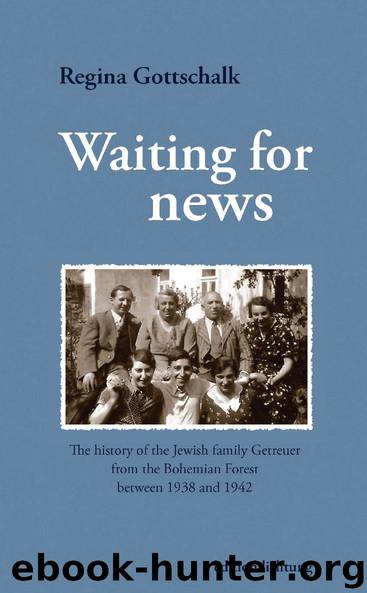
Author:Regina Gottschalk
Language: deu
Format: epub
Publisher: lichtung verlag
Published: 2019-03-15T00:00:00+00:00
Hoping to emigrate: “patiently waiting for our turn to come”
In the beginning the National socialists’ political measures taken against Jews were supposed to compel Jewish citizens to leave the country. Through systematic smear campaigns, deprivation of rights, confiscations, social exclusion and finally violence, they intended to make their lives so miserable that they would consider emigration their one and only solution. The younger Jewish generations felt more directly threatened than the older ones and therefore it was them who were quicker to risk the step into an uncertain future.
1939 was the year of the great exodus which also reached the Protectorate of Bohemia and Moravia – those who were able to, fled to the USA, England, Palestine or any other country that semed to be safe to them. In late fall, Frieda agitatedly reports about her relatives and friends:
Paul and Irma and Buxbaum are still here. Löwy Ernst is also hoping to leave this week […] Otto also wants to go to Palestine. Mandler Friedl has already written to us while travelling away. Mimi was here and told us she is also supposed to leave for Denmark within the next few days. Adolf Eichmann was in charge of emigration issues, managing the Central Office for Jewish Emigration (Zentralstelle für jüdische Auswanderung) in Prague. It was there that one had to apply for the emigration documents. German officials were piling up regulations to hinder those who wanted to emigrate: All personal details had to be given, valuables had to be listed, and proof given that they were free of debts. They had to have an up-to-date criminal record and confirmation that they had paid emigration tax, verification that they held a visa for a specific country, boat tickets and the so-called arrival fee had to be presented, otherwise their application would not be processed.
But compared to how difficult it was to get a visa for safe countries, all this was marginal. Almost all countries they would consider going to eventually closed their borders to persecuted Jews. England only took a limited number of refugees as they were struggling with economical problems. As they also had mandatory power in Palestine, Great Britain also restricted immigration there dramatically. The USA, which for many was the most attractive country to emigrate to, was rather restrictive. The USA referred to an immigration law from 1924 which established immigration quotas from each country. The quota for Germany, Austria and Bohemia was 29,000 people per year, although this number was not always reached. 1650 Bohemians were allowed to immigrate in 1939, in 1940 it was only 704. Those who had lots of money were welcome. Jews in the German sphere of power whose assets had been confiscated could not profit from this “courtesy”.
What were the reasons for the USA’s restrictive immigration policy? The USA was still struggling with a high unemployment rate due to the latest economic crisis. They were afraid of foreign infiltration; even anti-Semitic tendencies had become common in the 1920s, mainly directed at Jews from Eastern Europe (“Ostjuden”).
Download
This site does not store any files on its server. We only index and link to content provided by other sites. Please contact the content providers to delete copyright contents if any and email us, we'll remove relevant links or contents immediately.
| Africa | Americas |
| Arctic & Antarctica | Asia |
| Australia & Oceania | Europe |
| Middle East | Russia |
| United States | World |
| Ancient Civilizations | Military |
| Historical Study & Educational Resources |
Room 212 by Kate Stewart(5119)
The Crown by Robert Lacey(4814)
Endurance: Shackleton's Incredible Voyage by Alfred Lansing(4780)
The Iron Duke by The Iron Duke(4354)
The Rape of Nanking by Iris Chang(4211)
Joan of Arc by Mary Gordon(4109)
Killing England by Bill O'Reilly(4001)
Say Nothing by Patrick Radden Keefe(3983)
I'll Give You the Sun by Jandy Nelson(3445)
Shadow of Night by Deborah Harkness(3366)
Hitler's Monsters by Eric Kurlander(3341)
Mary, Queen of Scots, and the Murder of Lord Darnley by Alison Weir(3210)
Blood and Sand by Alex Von Tunzelmann(3203)
Eleanor & Park by Rainbow Rowell(3169)
Darkest Hour by Anthony McCarten(3129)
Margaret Thatcher: The Autobiography by Thatcher Margaret(3081)
Book of Life by Deborah Harkness(2937)
Red Famine: Stalin's War on Ukraine by Anne Applebaum(2932)
The One Memory of Flora Banks by Emily Barr(2862)
